AI Writes the Code Devlens explains it.
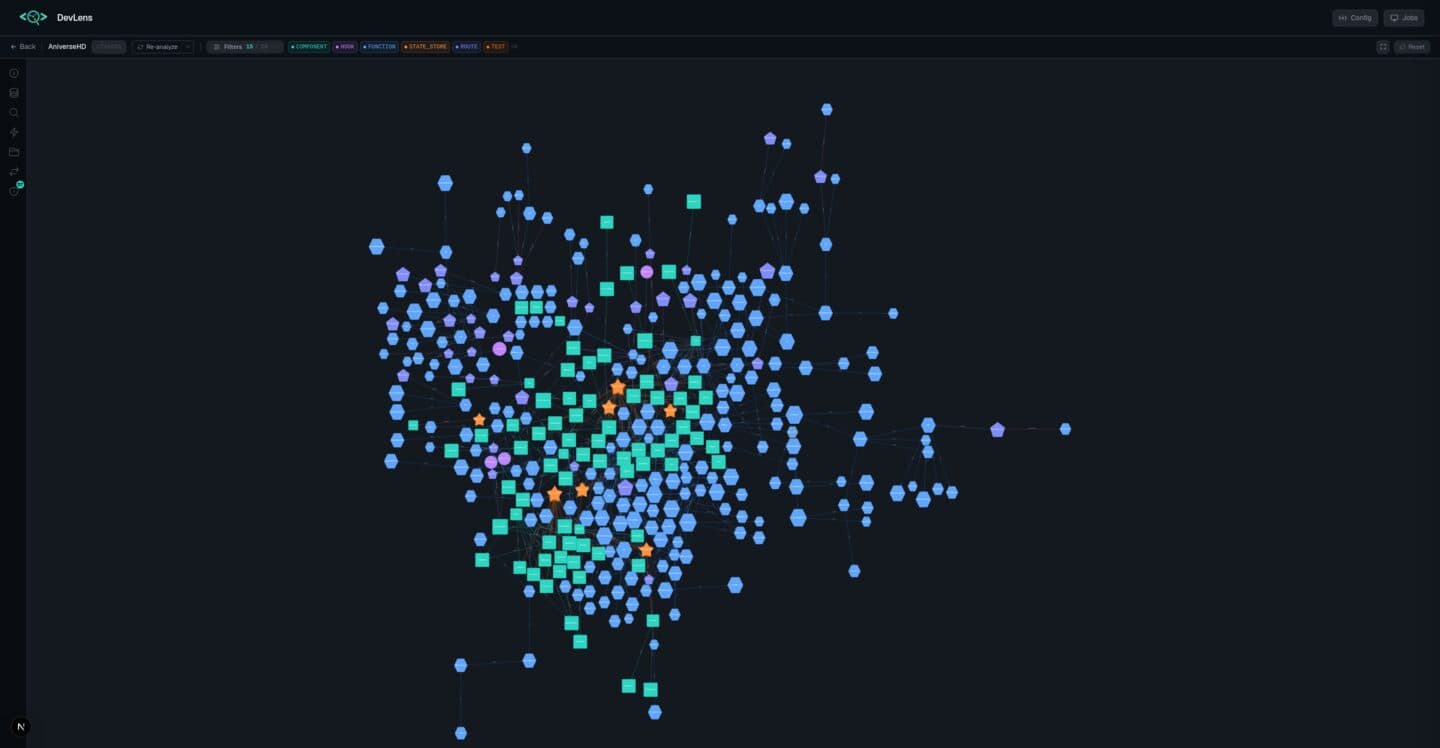
Transforms any TypeScript or JavaScript repo into an interactive dependency graph — with AI summaries, security analysis, and commit diffs. Runs entirely on your machine. Your code never leaves.

Built to understand your codebase, not just read it.
State Intelligence
Knows your state layer
Detects Redux, Zustand, and Jotai stores and maps every component that reads or writes to them — including custom hooks that wrap store access — so you can see your entire state graph, not just isolated files.
AI Summaries
Two views per node
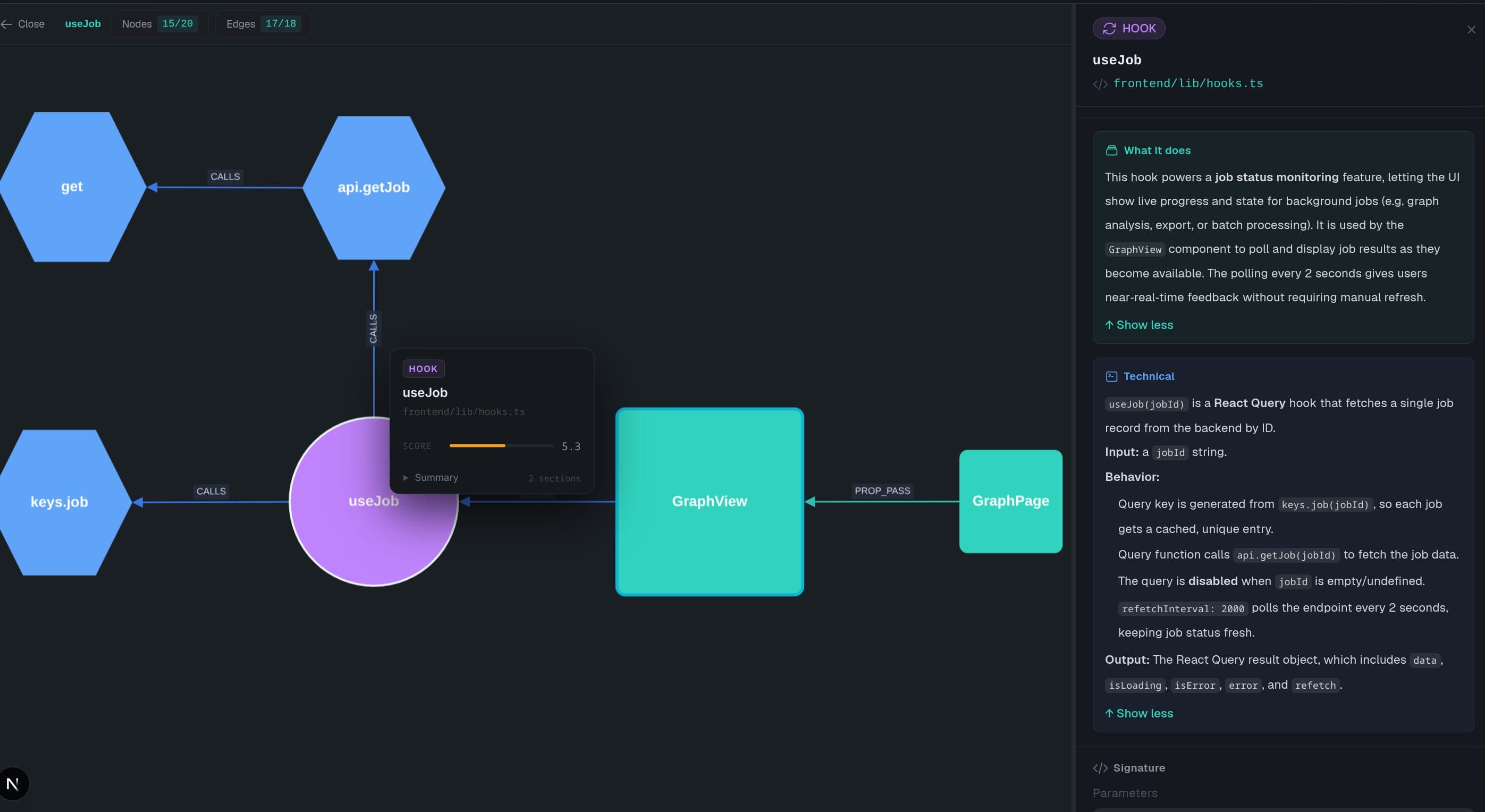
Every node gets a business summary explaining what it does in product terms, and a technical summary explaining how it's implemented — generated automatically across your entire graph.
Deep Parsing
Full AST analysis
Walks every .ts / .tsx / .js / .jsx file extracting every meaningful node — components, hooks, functions, stores, utilities, and API routes — with 10 relationship types connecting them.
Checkpoint & Resume
Pause mid-job and resume later. Atomic writes mean zero data loss on crash.
Importance Scoring
PageRank + fan-in/fan-out + type bonuses. Filter by threshold to focus on what matters.
Commit Diffs
Compare any two commits. See added, removed, moved, or re-scored nodes at a glance.
Route Entry Points
Detects Next.js, Express, Fastify, Koa routes and expands full call chains via BFS.
Smart Reuse
90%+ unchanged nodes reuse existing summaries — no cost, no waiting on re-runs.
Runs 100% Locally
Your code never leaves your machine. No cloud upload, no third-party storage.
Engineered
for depth.
vs. LLM agents
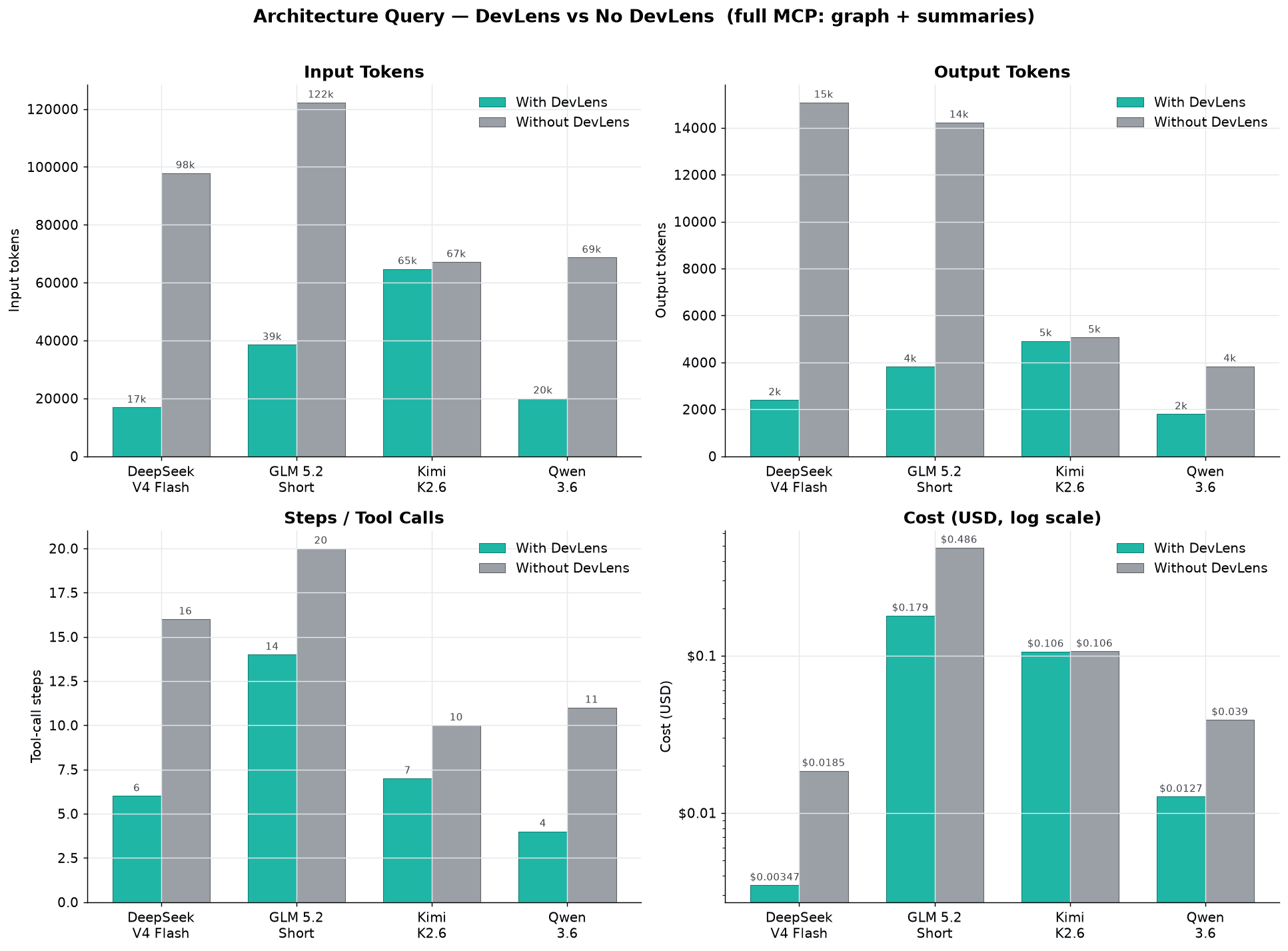
Cursor and Copilot re-read raw files on every query. DevLens summarizes once — every future query uses structured graphical context with summaries, not raw source code. Fewer tokens, better Understanding.
Fingerprint repo
Detects framework, language, router, state manager, databases, and data fetching patterns.
Walk the AST
ts-morph parses every TypeScript and JavaScript file. Extracts all nodes — components, hooks, functions, stores, utilities, and exported route handlers.
Detect all edges
10 parallel detectors build the full dependency graph. Calls, imports, state reads/writes, prop passing, event emission, route handling, and auth guards.
Score every node
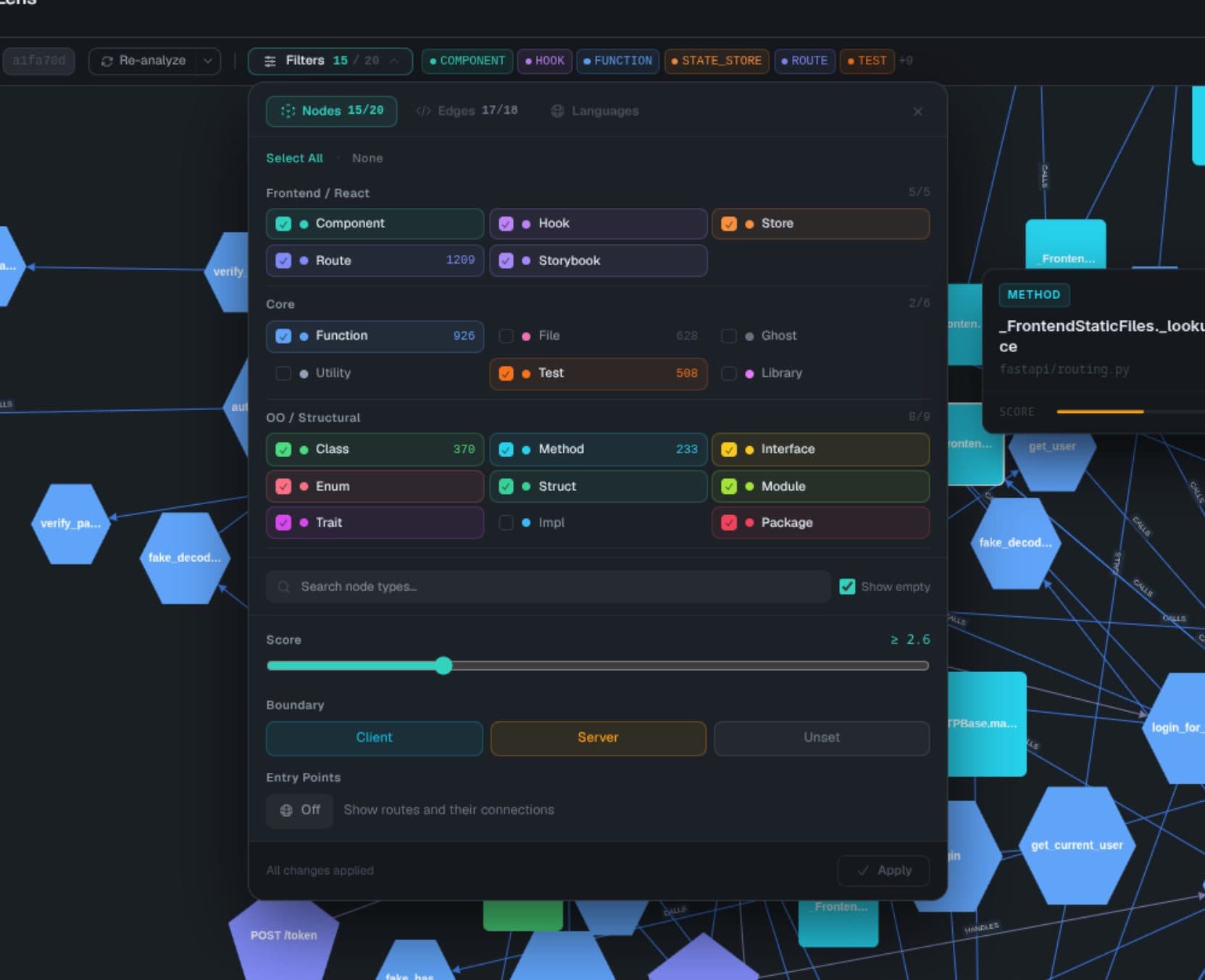
Multi-pass importance scoring ranks every node by architectural significance. Noise filtering removes low-signal nodes.
Token efficiency
Tools like Cursor and Claude Code re-read raw source files on every query, burning tokens to rebuild context each time. DevLens summarizes your entire repo once — every future query uses structured graph summaries instead of raw code. Fewer tokens, faster answers, lower cost.
Summarize with LLMs
Each node is summarized once — business logic and implementation — in topological order. Checkpoint system allows pause and resume at any point.
Explore interactively
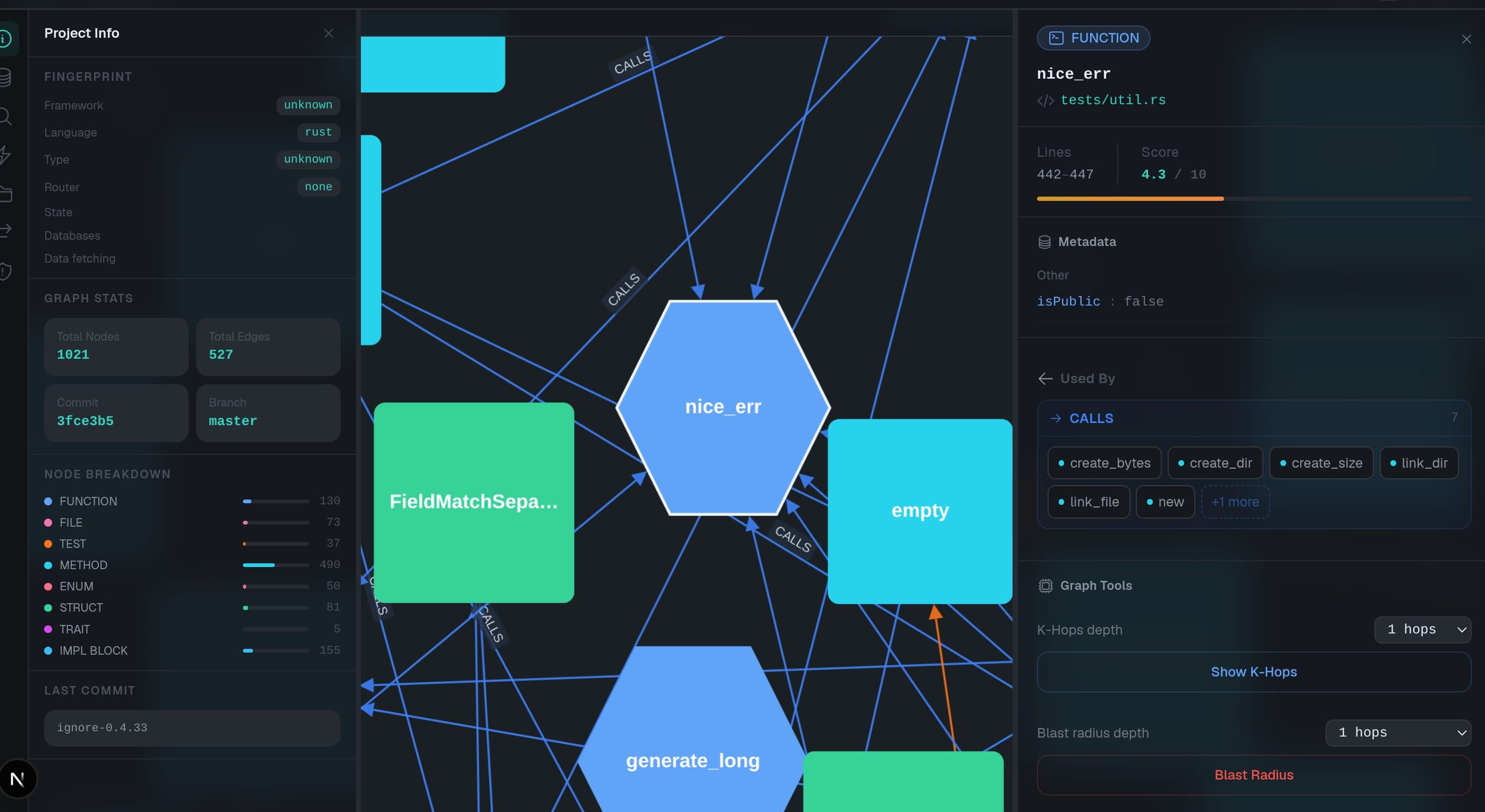
Interactive graph with filters, search, K-hops, blast radius, commit diffs, and security panels. Everything runs in your browser.
Where it clicks.
Real workflows where DevLens replaces guesswork with graph-backed clarity.
Onboarding engineers
Fast-track codebase understanding for new members. Reduce ramp-up from weeks to hours.
Blast radius analysis
Understand exactly what breaks downstream before merging. True impact analysis for PRs.
Architecture audits
Surface bottlenecks, circular deps, and high-importance nodes. Find load-bearing code before it breaks.
Security reviews
All high/medium/low risk nodes in one panel. Filter, search, click to inspect source.
Living documentation
Every node gets a business and technical summary. Your codebase documents itself.
Refactoring with confidence
K-hops shows the neighbourhood. Blast radius shows what breaks. Move fast without breaking things.
The AI age problem
AI writes the code. DevLens explains it.
Cursor, Claude Code, and Copilot let you ship faster than ever — but speed creates a new problem. Codebases grow faster than anyone can understand them. Developers merge code they didn't fully read. New hires drown in unfamiliar structure. Even authors forget why things are wired the way they are. DevLens turns that black box into a living, queryable map — so your team always knows what was built, how it connects, and why.
Not just for teams. For anyone who ships code.
DevLens Cloud adds GitHub integration, a full LLM interface over your graph, and instant graph sharing — whether you're a solo dev, open source maintainer, or onboarding a team of fifty.
Solo dev
Own your architecture
Share a live graph link with anyone. No setup, no account needed on their end — just a URL.
Team lead
KT in minutes, not weeks
New hire joins — share the graph. They explore auth, payments, and cart flows on their own, at their own pace.
Open source
Document with a graph
Ship a graph alongside your README. Contributors understand structure before they write a single line.
LLM Interface
Ask anything about your codebase
Backed by your graph, AI summaries, and semantic vector embeddings — ask in plain English and get answers grounded in your actual code, not hallucinated docs.
→ "What happens when a user adds something to cart?"
useCartStore (Zustand) receives an ADD_ITEM action via addItem(). It updates cart state, which triggers CartSummary and CheckoutButton to re-render via the READS_FROM edge. The total is recomputed in useCartTotal hook...